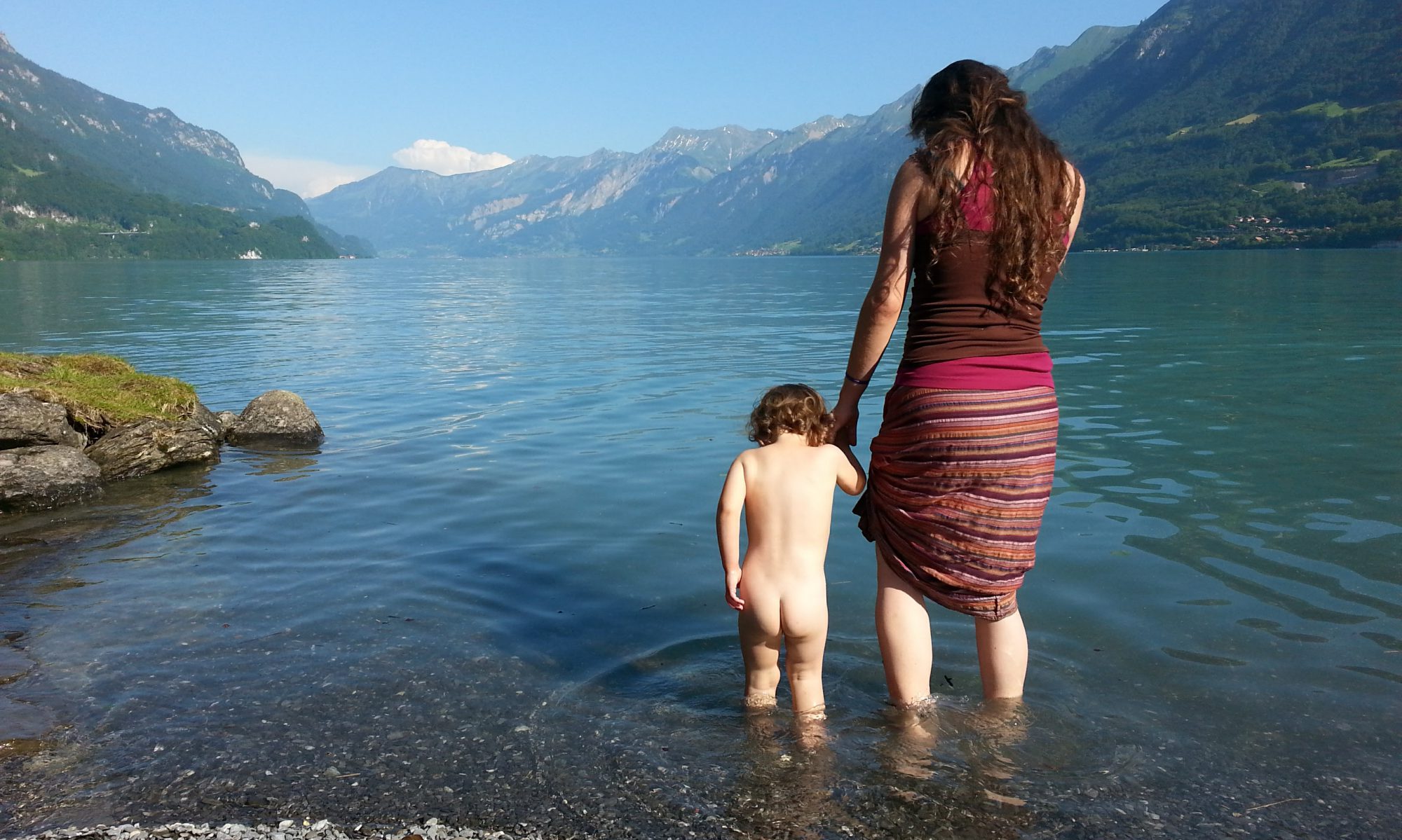
We’ve been traveling for 16 months now. Most accurately captured like a toddler’s age, our quest is no longer measured in weeks, not yet in years. During the first three months alone we flew ten times, carrying the kids out of beds in the middle of the night, plunking them in a car for hours before weathering a transoceanic flight, and then driving a few hours more before depositing them in new beds. We went on planes—pink, white and blue—trains, buses, trams, funiculars, boats, rodelbahns and cable cars. But it was only on a recent three and a half hour car ride to Barcelona that Oliver discovered the much-dreaded childhood refrain, ”When are we there?”
It bubbled out of him in the first half-hour of the ride, as Silvery was making her steady way up a beautiful mountain pass and I was still hoping to glide on the fumes of his usually dependable automotive enthusiasm, not nearly ready to break out the snacks. “When are we there?” And then a minute later again, and again, and again, in a crescendo of longing and despair. Like the shadow twin of the riddle about how many times one can fold a piece of paper, we soon found out that there was an infinite number of times a 3.5 year old could fold “When are we there?” into one car ride.
I tried truthful answers: Three hours and four minutes. Still three hours and four minutes. Still. Three hours and three minutes. I tried preposterous ones: 3,000 hours! Never! And absurd: Green! Dinosaurs! I went the Zen route and explained that we were already There, Now. Where is “there,” what is “when?” I asked. But none of it seemed to help—except, finally, making it to our Airbnb, 184 “When are we there”s later.
We began dreading the drive back to the place we were then—about two months ago—calling home, and re-thinking our crazy 12-hour drive to Portugal. So we were pleasantly surprised when the car drama seemed to fizzle out as suddenly as it had appeared, and somewhat unprepared when it turned out that instead of drying out, the spring of despair was overflowing into our daily lives. “When are we there?” suddenly, with a mouth full of pasta. “When are we there?” in the middle of a nursing session. “When are we there?” as he ran out naked from the shower. “When are we there?” whenever there was a lacuna big enough to bear it.

A few weeks ago, as part of the getting-to-know-each-other ritual we have performed so many times during the last 16 months with every stranger-friend who’s crossed our path, someone asked me about my roots. It was a refreshing and useful alternative to “Where are you from?” the question that slowly, as we diligently accumulated more and more “from”s, has become the bane of my existence. When I struggled, still, he thoughtfully offered his algorithm for response: Where would you go when shit hits the fan?
That was the second time in the space of a month that someone had asked me that question. The first was my dad, Abba, who, during his week-long visit with us in the same place we were then calling home, couldn’t seem to get beyond his Oliver-esque refrain, “When will you be there?” and variations on its thematic companion, “What will you do when you can’t get there?” What, as Vonnegut liked to say, will you do when the excrement hits the air-conditioning?
No amount of explaining to my son or to my father that we are both already there—here?—and don’t know when we’ll get there, has seemed to help. This is it, folks, I tried to say: both our path and our ultimate destination. Huzzah! We are living proof of Schrödinger’s cat state; in our own little quantum version of Amazing Grace, we now are lost and now we’re found.

When Oliver was ten months old, I packed him into his Ergo and rode a bus and train and bus to a women’s retreat in the desert. Already deeply enamored with locomotion, he barely blinked an eye. I arrived late in the evening, just in time to grab a bite to eat and settle onto a mattress on the floor, alone in a dark room with nothing but a baby.
I remember the welcome yet unnerving feeling of sleeping away from home, how I experienced myself through subtraction: my breath a pulsating rest from the ambient silence of the house, my waking silhouette a portrait of negative space on the wall. I remember the frustration of not being able to delve as deeply as I had wanted to—needed to, pined for—into that space, the demands of parenting a truly unrelenting, if familiar and convenient, crutch. And I remember the moment the Wanderer appeared, the moment I conjured her up—or maybe she conjured herself up, slithering bravely through the cracks I was stubbornly prying open.
She was a witch of time and space, never wanting for either. A deep-rooted tree and an endlessly adventurous free-spirit. Ease flowing out of her fingertips, my impossible vision taunted me as she cooked with a baby at her breasts, while also managing to seem accomplished and fulfilled.
I remember how out of reach she felt, how blinded I was by her shiny exterior, and how small and dull I felt in comparison. And I remember how close she turned out to be, how redeemed I felt when I finally acclimated to her brightness and dared look into her eyes, only to recognize them as my own. Turns out I had spent a lifetime honing that Wanderer-essence: being in tune with that which is within, taking my insides seriously.
That was the last time I had retreated, almost on my own. The only other time was three months prior, when I packed a younger-still Oliver into his Ergo and hitched a ride to the desert, this time to a women’s festival. I spent hours, then, standing in the sand, watching a woman in a black tutu and leopard faux fur cut coiffure after coiffure into an asymmetrical mess.
I didn’t like most of her haircuts—though I wanted to—yet could simply not look away. Unable to resist the chair’s gravitational pull, I could just make out the sound of my voice as I asked her to chop off the hair I’d been growing for decades, the hair I would be relieved to feel as I awoke from another nightmare, the hair I had hoped could hide everything.
When I came home then (and my hair didn’t), Ella couldn’t hide her grief over the loss of her long-haired mama, and as I put a comforting hand on her forehead I could feel the fever her father’s hand had missed. Three months later, as the Wanderer returned home after another public transportation marathon, Ella coughed the first of what, eventually, would turn out to be a long and trying illness. And not long after that, the Seal made his premiere, setting in motion the trajectory that would eventually catapult us out of Israel’s orbit.

Two weeks ago, we moved again, this time to the north of Portugal. Before each move, I find myself suspended in cat state, my consciousness flickering between relief to be moving on, and reluctance to be leaving the familiar. My ambivalence manifests in laundry and shower angst: When, I try to calculate, is the optimal time to put in our last load of laundry? When should we take our last shower?
Oliver’s ambivalence tends to manifest in a concern for a shortage of cars and beds: Will there be cars there? Is there a bed? And since Barcelona, When are we there? It comes out of him when I am least prepared, shooting like an arrow homed for my heart. Homed for home. He asks, “When are we there?” and I hear, “Where is home?” “How far is home?” Sadly, while the stranger-friend’s algorithm works—the answer to both questions, just barely, is Israel—it still doesn’t provide the coordinates to our home.
Indeed, our home-seeking tour has been a prolonged exercise in serial heartache; willing ourselves to fall in love with place after place has become progressively harder, as we watch yet another alternate reality slowly dissolve. Chronically heartbroken and tired of packing and unpacking, we find ourselves pining for community, for a literal piece of earth into which to dig our roots, and in the meantime a temporary home to afford a modicum of stability for us all. But we also breathe a sigh of relief as we pack our bags into Silvery for the umpteenth time, thrilled by the whoosh of the wind and the unknown as we speed away from one home, towards another.
When Oliver isn’t asking me existential questions, he’ll often say things like, “Nene, why are there two red knives? When I was big and you were small, did you also ask me why there were two red knives?”
“But I already showered tomorrow!”
And, “Are you thinking what I’m thinking?”
Probably not, my time-fluid little-big one who has already showered tomorrow, probably not.
That is why yesterday, caught off-guard by an early morning barrage of Oliver’s existential dread, I asked him if he could see the future.
Yes, he said. I can.
So Oliver, When are we there?
Three minutes, Nene.
No, two.
 All of the Worlds
love it, love you, miss it, miss you….see you in two minutes then! xxx
LikeLiked by 1 person
No, one. ❤️
LikeLike