After my mother died, for a brief moment that lasted a few months, I wasn’t afraid of death. I had sat with her, dying, praying through and for it like I only ever did again when trying to stave it off; I had breathed in its sacred mundaneness as she exhaled her last, seen with my own eyes how the switch was turned off, with some effort—but with overwhelming ease. I wasn’t afraid because I had peeked behind the curtain and understood, deeply, that death was part of life. I had internalized its inherent rightness.
Also, nothing made any sense anymore and it didn’t especially matter if I died: my mother was dead. The world would keep revolving, just like it did, unbelievably, after she stopped. And also, despite holding no structures of belief to support this, I harbored a secret hope that she’d be waiting for me there, out of time, where anxiety has no place.
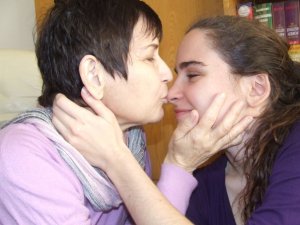
I wrote this bit above as I woke up this morning, to the 9th anniversary of Imma’s death. A year ago I sat in a cold yurt in the foggy south of France, stealing a few moments of precious exile from the children, rocking back and forth calling out my mom’s name.
Today I’m in sunny Portugal, having just returned and still in recovery from yet another tumultuous family reunion—this time, his. I sit here with my hands on my heart, at the end of a stealthy session of morning yoga, and my mother is so close, I don’t even need to whisper her name. With the soundtrack of my kids bickering downstairs, I am her. On a sunny day like today, the blessing of her passing is so much closer than the curse.
Having gone through every yahrzeit but the first with at least one child in tow, I have learned to relinquish control of the day. All I wanted, I decided, was a family hike and a bit of time for myself. Oliver needed some convincing, so I hinted that Savta might have hidden chocolate in the forest. Ella asked me to let Savta know that she’d rather have something else, as she began collecting flowers and found objects that Savta might like.
Did she like pine cones? Did she like blue? I started singing Matti Caspi’s “Makom Le’De’aga,” Ella’s hand in mine, Haff and Oliver trailing behind. Nine years ago plus a day, mom sat listening in her white armchair, as Muz and I harmonized by the piano. We sang “Makom Le’De’aga” then, too—literally translated, “A Place for Concern,” or “Room for Worry”—and again at the funeral. I’ve sung it every yahrzeit since.
I wasn’t thinking about it this morning, as I wrote the line about mom waiting for me where anxiety has no place. Words are precious to me, but my love for songs has almost always been more about melody than lyrics. So I was somewhat unprepared for the cosmic token to drop when Ella started quizzing me, in her tentative Hebrew, about the words of the song. Why can’t you pick the flowers? as she collected flowers for Savta. Why is this God so worried? Where is this place?
During the fall edition of our family strife—this time mine—my father’s partner had tried to appease me, touchingly, by explaining that my father was just worried about me. It’s a father’s job, she said, to worry about his children. “Job” doesn’t sound right, I thought—more like an inevitable side-effect—and I suddenly understood the hopelessness of this fateful entanglement: the Hebrew verb “to worry” also means: “to care for.”
Is the God in the song worrying, or caring? I found myself wondering. Is it, instead, a caring place? Ella lost interest in the song, just as mine was gathering speed, and started asking me when Savta was going to hide the chocolate, and whether Savta had remembered that she wanted something else. Even as I told her, after the third time, that she could either stop or go join her father and brother in the back, I could feel the shifting of the tide—how it was the first yahrzeit to go according to plan without a plan; how I was fully in it with and because of the kids, and not in spite of them.
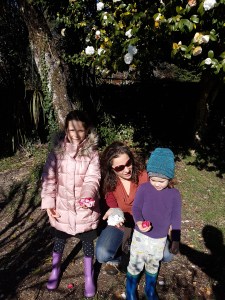
She squeezed my arm again, and I gave her a menacing look that gestured backwards, and she said, No, no, it’s not about the chocolate. How did earth come to exist? How could it not have existed? How could nothing be? Those are all really good questions, Lulu, I said. What if earth goes into a black hole when I’m still alive? She continued. I don’t want to die. I don’t want anyone to die.
Then Savta hid the chocolate (and granola bar). Oliver is not fully indoctrinated in the ways of Secret Savta yet, but he played along. Invisible elders leaving presents for him? That checks.
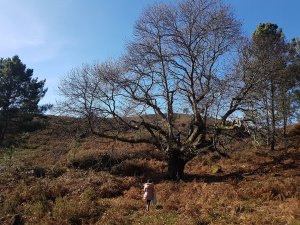
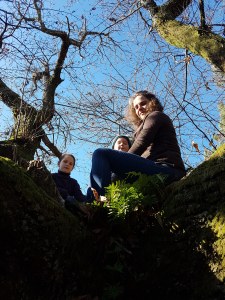
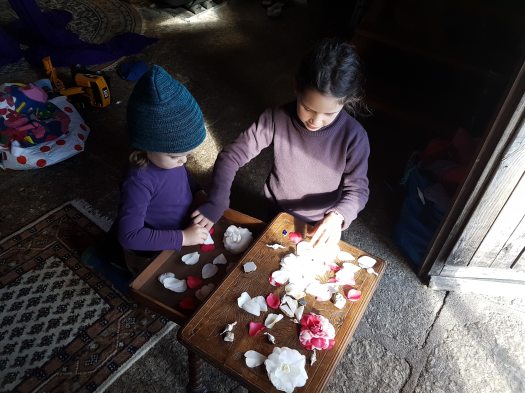
We climbed a beautiful chestnut tree. Oliver said, chocolate melting in his hand: I think this is very high. I think I’m feeling a little scared. Haff held his hand. We took a few photos. Oliver said, I think it’s time to go down now. Twice. So we did, and walked back home to make a tuna summer roll lunch Savta would have loved, while the kids worked on her altar.
Nine years later, my inoculation has all but worn off. Having two children hasn’t helped, of course: fear of death is my base frequency. When Ella was two, I wrote about how being a parent was like having your heart in someone else’s body. I wrote about how I often feel like the giant in the fairy tale who keeps his heart in an egg, in a duck, in a pond, over the hill—except that my heart is entrusted to a little munchkin who really likes jumping off of dangerous things. Luckily, six years in, I have another munchkin who is sometimes a little scared. There is hope yet.
 All of the Worlds