It started, in Holland, with a black plastic spatula sent as a gag gift—a late-night Amazon delivery meant to make us laugh, as we were busy crying. It was the closest thing to a hug my two dearest friends could muster as I drifted in the wake of a family fracture, across an ocean and a sea. Then, as if a dike had been breached, came the cheese slicer and cheese grater.
Exactly one year earlier, I was roaming the Christmas market in Albi, South of France, entertaining puzzled vendors with my best impression of a cheese slicer. When I unearthed it from a tangled heap, it felt like our very own Hanukkah miracle. We cherished it so—for the three weeks we had it—before shedding it like old skin as we sped toward a fresh destination in our new—but otherwise very old—silver car. It knew we could offer it no home. It couldn’t stick to us then; not much could.
Now, it seemed, we couldn’t keep anything off—even as we continued to pay our respects to the nomadic gods. “We probably don’t have enough space for this in Silvery,” we’d say, just loud enough for our newly purchased cheese slicer and grater to hear. Still, unperturbed, they tagged along on the five-day trip back to Portugal.
And since then, having put out a homing beacon, they’ve been joined by their kin: a flexible spatula—a Salazar, as they call it here—a garlic press, a bulky wooden cutting board to replace the red plastic one we’ve trekked across the globe, and a much-pined-for apron.
Throughout the years—nineteen this June—Haff has learned to lay low during my often arduous decision-making process. He likes to tell people how we went on all the hospital tours—even though we both knew I would give birth at home—or how we never missed an open day at the local kindergartens—even though the kids stayed home year after year.
He says this with a smile that I sometimes take as belittling, but is mostly meant to call me back to our shared moment of insight. To that quiet moment before the storm, when we both know the answer, even before I start frantically jotting down all the questions. It’s a waiting game of sorts: the storm there just to distract my mind while it finds its inevitable way back to that quiet, catching up with what my gut has been saying all along.
Most of the big decisions in my life—at least, the ones that seemed big from the outside—have been about flight, quite literally, with few strings attached. Once, notably, I was cornered in a park on the outskirts of New York by the man I had been living with for seven years. In response to that four-word question, all I could muster was a “Maybe later, Haff.” It had become a running gag, with a special twist, since we had already been secretly married for six years—just a little over a year after we first met, as if by chance, in New Zealand.
But, like all good jokes, it grew out of a kernel of truth.
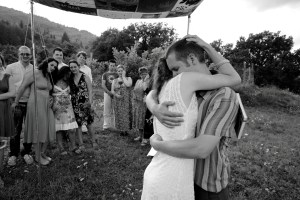
When I wrote to my friend about having finally found our home, she said my email unfolded like a love story. She was there, over a decade earlier, when we stood under a patchwork Chuppah in an open field in Tuscany, all eighteen pairs of eyes brimming with tears as Haff bared his soul in all its romantic glory. And there was not a wet eye as I hesitantly offered a glimpse into mine: Every decision carries within it all the other choices, forever discarded, I said. I see them all—and still, I choose you! I serenaded, in all my romantic glory. That is, I choose you today. Maybe tomorrow.
But the day after, who knows? Let’s see.
In high school—and later, in college—I used to study with music blasting at full volume. Only great noise could drown out the cacophony already in my head, and summon the quiet my mind craved. But alongside the chaos, there has also always been that still place, where I could calmly trace the thin golden threads that wove my life together.
Even as I resigned myself to my earthly decision-making duties, I rarely missed the teasing winks of kismet; the stolen glances at the completed book as it was being written. Confronted by questions from the concerned and bewildered for which only time had an answer—Why New Zealand? Why Portuguese?—I’d learned to recognize the intoxicating tingle of intuition.
And here, in our little stone house in the north of Portugal, our intuition was manifesting all around us in the form of rapidly multiplying kitchen utensils—making the decision for us, as it were. Also making the decision for us: Haff, who had gone ahead and leapt ahead of me, literally planting seeds of giant sequoias and redwoods while waiting for me to make up my mind.
Alone, I was left to determine whether this was the place where we finally hang up our boots, the moment we interrupt the perpetuum mobile of packing and unpacking that has been our life for nearly two years—but really, nearly two decades—and possibly, my entire life.
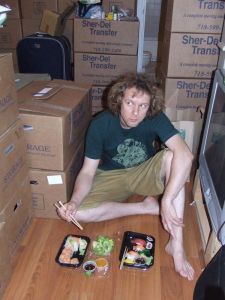
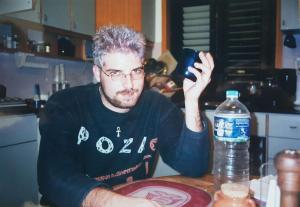
A few days ago, as I was putting the kids to sleep, I came across an old photo of a friend sitting in the kitchen of my childhood home. I had taken that photo and knew it well—and the occasion for its reemergence was a happy one: my friend’s 40th birthday.
So I was unprepared for the flood of emotion and tears as I was suddenly right there in that kitchen, my whole childhood spread out around me like a Proustian buffet. Subtle as it was, I couldn’t help but follow the siren call of the photo’s unsung heroes: the wooden salt shaker, the ceramic honey jug with its sticky cork lid, the ugly plastic placemat on top of the round wooden table, the translucent blue glass in my friend’s hand.
And intimated in every detail: my mother—the ghost of kitchens past.
Louder still were the protagonists that didn’t make the cut: my bedroom, just steps away, with its loft bed and teenage-angst-scented lungis; with memories of awkward first loves, of my mother holding my sleepless feet, of independence conceived in darkness, carved out of song.
And beyond the bedroom: a family growing together and falling apart, a cancer coming and going, and at least one violin always tuning its strings.
A vestige of earlier times when the burden of choice was not yet mine; it is a home I didn’t need to choose—a home I didn’t make. It is the home that made me. I am always sick for that home, as Ella used to say—missing it the way you only ever miss something you never really had.
My sigil still glowing deep in its foundations, I am forever outraged that someone dares mistake it for their own. Yet in my youth, I could barely wait to outgrow it; in my recurring nightmare I am eternally trying to escape it, the lock invariably conspiring to keep me in.
And in my haste, I leave some parts of myself behind: some permanently severed, phantoms in a ghost house; others securely attached, still pumping blood.
I remember sitting down to write my wedding vows in that villa in Tuscany, overwhelmed by a vague sense that I needed to come up with the perfect answer to the wrong question. And here I was again, in a similar predicament—on a quest for a home. Like an atheist searching for the Holy Grail, I was mired in internal conflict and wholly unqualified to tell the Grail from any old tarnished goblet.
“I’m not looking for Shangri-La!” I kept reassuring my father when he’d try to convince me that good enough is better than perfect. But, in truth, I was: whatever concessions would be required of us, I was hoping they’d be rather painless. Though my body ached for it, I hesitated to embrace the transition from vigilance to coping—to luxuriously surrender to the imperfections of a life of my very own.
But this dream refused to die. Instead, for every carefully constructed list of flaws I threw at Haff, it gained another coat of magic. When I learned, for instance, that the friends from whom we’d be buying the land had named their farm Hippie Garden, I joked that a simple Google search might have saved us a lot of trouble. And I didn’t yet know then that the paper describing our land—an old Portuguese deed—simply read: Land with Olive Trees.
Roughly four years earlier, I was staring down at our pixie-like newborn who defied all names and looking back at Haff, tentatively offered: “Oliver?” “Oliver.” Just to make sure, we looked up the etymology—and knew we had it right when, in addition to olive tree, the old Germanic origin turned out to be: He who summons the elf army.
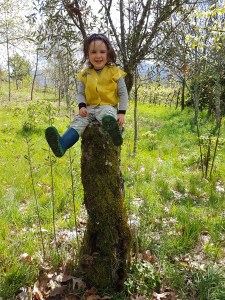
I was thirty-four when I gave birth to Oliver and thirty when I gave birth to Ella—exactly as old as my mother had been when she had her children.
I remember how disconcerting it was to realize that I had conceived my eldest at the same age, to the month, that my mother had conceived hers. It was two months after my mother’s death and just a few months after Haff and I made our impromptu return to my homeland, to take care of her.
The first time my family returned there, also from New York, my mother was thirty-eight—just as I was, until recently. And her children—my sister and I—were four and eight, just as mine are now.
Thirty-eight, four, eight: the mythological constellation forever associated in my mind with the return to a homeland—the secret combination that unlocks the cryptex with the map of Home.
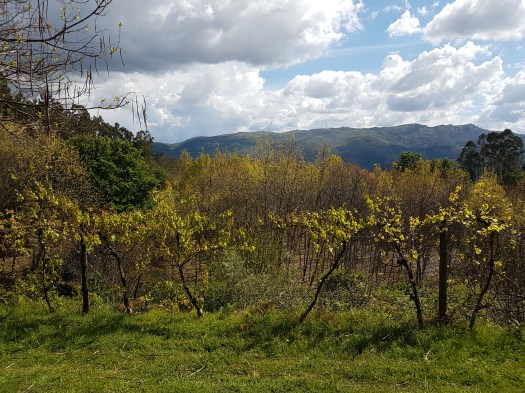
So, two days ago, as we woke up to my thirty-ninth birthday and, as it happened, to our first day overlooking the Land with Olive Trees, I found myself wondering how much of this had already been written.
Among so many other things, there were my Portuguese lessons at NYU even though I’d already fulfilled my second language requirement at birth; my decade-old ceramic sculptures revealed as architectural models for our fantasy earthen home; Haff’s years volunteering on backcountry trail crews coming into good use building dry rock foundations—my forester husband, finally with a forest of his own.
And there I was, right in the middle of it all, barely able to hear myself think over the cacophony of Chekhov’s guns.
Already exploding—in a great, silent bang.
 All of the Worlds