I’ll start from the beginning.
We read the biopsy results on our way to the farmer’s market in the oldest city in Portugal—a spot I can no longer drive by without wincing. I mostly remember looking at Haffy and saying, “What the fuck? I mean: what the fuck? What the fuck.”
I think I was smiling. I remember Haffy finally breaking down and crying, and saying he wanted to grow old with me.
For a little while, I was more pain than person—and pain didn’t need to breathe. As I came to, I reached across the gearshift and grabbed onto him, and we were both swept under that salty wave of sorrow, the kind that knows no ease.
But it was also a relief—a sign that, after weeks of wading in the sea of despair on my own, he was finally getting his feet wet.
Or maybe this was the beginning:
Those long weeks of uncertainty—after the ultrasound reassured us I was 95% benign, and before the biopsy pronounced me 95% cancerous—when we went about our days like two possessed alchemists, of very different schools of thought.
Haffy transformed his amorphous angst into a roof for our rapidly materializing octagonal home, my private sanitarium in the Portuguese countryside.
I transformed mine into more concrete angst: looking into the eyes of my children and imagining what their lives would be like without me—and watching the dream of a place of our own slowly slip away, just as it was taking form.
Or maybe it was this:
The sound of my mother getting cancer when I was fourteen: a phone ringing during a card game on the outskirts of Manchester. The hallway phone being picked up and put down; the phonemes of the unfamiliar word “malignant” reluctantly coming out of my host’s mouth.
My mother had flown back home for a biopsy and asked her not to tell me. We were going to a Kinks concert that night, and she didn’t want to spoil the fun.
A few days after that Kinks concert, I was on a plane back to my family—a crimson sunset over a sea of clouds and a late-night car ride from the airport to my post-op mother, green and parched.
Later, in a different hospital, I massaged her feet as she begged to die. Part of me died instead, and the rest went scavenging for her next dose of painkillers.
Later still—a decade, an ocean, and several metastases away—I sat in my Park Avenue office as my mother told me, over the phone, that she was thinking about euthanasia.
One of my most fragile memories is of my mother, an hour before she went to sleep for the last time. I was helping her in the bathroom—both of us standing there, looking in the mirror. In her frilly, floral white nightgown, she was like a bride on her wedding day—a quivering mix of dread and anticipation.
There I was, given a glimpse behind two curtains: behind the pretense of motherhood, and the illusion of life. I could almost see the bathroom walls flickering in and out of reality, the floor pixelating beneath my feet.
And in the midst of it, illuminated by that surreal disco ball, there she was: my mother, an immortal soul scared of the dark.
When I found out—or rather, when I was still technically 95% benign but 100% grieving—I told Haffy that I’d rather die than wage an elaborate battle.
I wasn’t angry, though I rehearsed the feeling for a short while. I wasn’t repulsed, either. Instead, I felt a strange tenderness for this intruder—a quiet camaraderie.
I wasn’t even regretful; it turned out I was happy with the choices I’d made. But I was terrified, and helpless, and heartbroken at the thought of not watching my kids grow up.
About leaving them motherless.
Worse still, I was tormented by my reluctance to walk through this particular hell for them.
And the kids caught on from the start—as they do—even before we had said a word.
Ella ran to me the day after the ultrasound, gave me a sad hug, and asked whether I knew what percentage of the world’s child population was orphaned. Then she crawled under my dress, so that I was instantly full-term with a nearly nine-year-old baby.
Oliver kept asking me why I was sad, and occasionally inquired about the time left until I’d die: “Nene, is it just two days until you’re dead?” he asked one night, mid-nurse, with his signature lilt.
I could only hope that, in my time-fluid son’s vernacular—where “yesterday” meant “all of the past” and “tomorrow” meant “all of the future”—”two days” was still very far off.
Growing up, I developed absolute pitch for different kinds of silence. I learned to dread the lacuna: the sound of something important not being said.
So we told them. I said, “I know you can feel something is up, and it must be so confusing. Here’s what’s happening. You can ask anything and speak with whomever you want.”
Ella asked if we could go to the gluten-free bakery, like we did after she had her procedure. Oliver asked if we could attach supersonic jetpacks to the car and fly to his grandfather. Then he asked if we could plant big trees on the roof of the car.
We said we’d have to think about it.
We went to visit my mother three days before my operation.
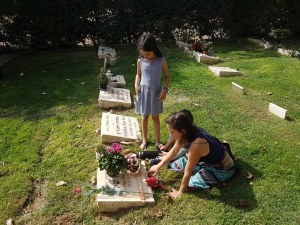
The kids chose flowers to lay on her grave, and—per our idiosyncratic tradition, to take back. Ella always looked forward to this, and I suspect my mother did, too. After all, it was one of the few indulgences dead grandmothers were allowed.
Then, I sent them to wait in the car while I lay in a fetal position on the grass that grows out of her, and sang and cried and sang and cried.
It was the closest I’d felt to her since she died: the easiest it was to talk, the most unburdening to cry, the most unaffected to stroke her gravestone. Death became our common denominator. I communed with her. Or maybe I prayed—I guess I prayed to her.
Or with her.
When I finally emerged from that trance about half an hour later, I found that a whole funeral had arranged itself in front of me. Unwittingly, I had been cast as the awkward warm-up act—an uncensored preview of grief ten years in, snot-face and all.
So, it seems I was wrong when I wrote once that I only pray on airplanes. Or maybe, life has taken a turn for the turbulent lately. Either way, I’ve realized that I pray almost every time I sing, or dance, or play the piano—or write.
And bumping our way through the air on this recent trip for my operation, I realized something else: that comfort gained from hope—not certainty—isn’t a lie. It’s faith.
When I promised Oliver everything would be okay, I didn’t have to know it for sure. Our plane was both crashing and not crashing—like Schrödinger’s cat, we were both dead and alive.
And so was I, quantum-dying. Except in my mind, I was only ever dying; the proverbial cat was always dead.
But when learning to navigate life after the unthinkable had happened, I had to choose to believe I would make it out alive. If I wanted to look into my kids’ eyes and reassure them, convincingly, that everything was going to be okay—I had to buy some stock in hope.
When we landed safely, against all odds, it was my first time returning to my motherland—my mother, dead.
I felt like a ghost haunting the corridors of her childhood mansion: comforted by the familiarity of its bones, baffled by the new tenants; always my home, and no longer my home.
I studied the backs of henna-haired older women, whose necks connected to their freckly shoulders just so, a bunch of stray red-purplish hairs caressing their napes. For once, I felt jealous of the women—instead of their children—only recently having internalized old age as a privilege that I may not be afforded.
I found myself contemplating how the best thing about getting old was that you get to get old.
My mother’s death at sixty-four—after a rich life and surrounded by loved ones—no longer seemed so tragic.
I couldn’t accept health and longevity as ideals anymore, or even as norms. If my short stint in a hedge fund had taught me anything, it was that buying stock in hope wasn’t enough; I also had to go short: I needed to reframe the horizon.
Why was living a long life seen as the ultimate measure of “success” in this game? I wondered. And what did this mean about me and my life, should I “fail” or “lose”—dying before some imaginary number we were all secretly counting on for my life to add up?
I was thinking all of these things—shouting them, really—at a flustered Haffy, the healthy half of what had begun to feel like a truly mixed marriage. We were sitting across from each other in a funky café, trying to disguise our urgent trip to see a surgeon—a rare date earned through extreme measures.
I couldn’t stop talking about how we were measuring life by health, how age seemed like the only currency that mattered—as I peered up at him from shadowland, waving my freshly minted passport and squinting in the brightness of his presumed health.
Then we ate French toast. We took the long way back to the car, wandering the cobbled streets like young lovers. And anticipating our every turn, there they were: white-on-black graffiti reading simply, “FUCK CANCER.”
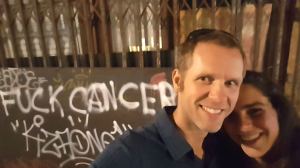
As the date of my operation approached, Oliver began asking, with increasing frequency, whether they had already taken “the thing” out of my throat.
He kept inventing increasingly elaborate scenarios of my impending demise. “Nene, when you die, Papa will drive us to Oma and Opa, because we will be all alone,” he told me one day, apropos of nothing. I mentioned that they would still have Papa, so he paused a little and then said, “Oh yes, I guess Papa still has long to live.”
“And me?” I asked, hesitantly.
“Oh, short, I guess.”
When I finally lay there—shower cap on my head, paper slippers on my feet—I tried to suppress a wave of guilty excitement, the kind I recognized from my brushes with danger or grief.
It was as if my wires had gotten crossed, and instead of feeling terrified or devastated, I felt something resembling glee.
I felt like my mother, that night—looking back at both of us from the bathroom mirror. Or maybe, it was the exhilaration of being elevated out of time—those rare instances when all dimensions collapse into one moment, and then the next, like stepping stones miraculously appearing across the river Lethe.
Or maybe—still—not glee or exhilaration, but relief: the simple permission to just be.
In the end:
I woke up slowly, then started trembling uncontrollably, like I did after giving birth both times—like a deer shaking off a close call with a lion. I lay there with my teeth chattering, an exhaust hose warming me between the blankets, when Haffy’s floating face suddenly appeared with the good news: they managed to remove the whole tumor and only half of my thyroid, just as we had hoped.
I stared at a clock across the room—time was running again, if in need of a jump-start.
Or maybe this is the end:
The morning after the operation, when Haffy and the kids came to pick me up and deposited me in a room of my own—my first room of my own in nearly two decades.
They’d come up, night after night, to give me a hug before retiring to their bedroom—Oliver parting with an ever-growing ritual chant that began with an anticipatory “I love you, too,” and continued with “Sleep tight, don’t let the bedbugs bite,” and “See you tomorrow.”
He soon added the telling refrain: “I promise to always be your son”—his answer to Ella’s “All the love in all of the worlds.”
Together, they were covering their bases: forever, everywhere.
Or this?
A little over two months ago, I had half my thyroid removed. I cover my shiny new scar with a cowl, like the girl with the green ribbon from that haunting childhood tale—and wonder if my head might fall off.
I still don’t know how I’m supposed to live, in a world that kept revolving after I didn’t die.
But I do know I feel better when I manage to tune in to this moment, right here: this world.
So, to Oliver’s nightly prayer, I always respond with our habitual call and response: “I promise to always be your Nene.”
And I hope—more and more, I believe—that I will.
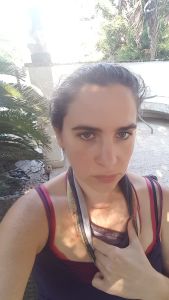
 All of the Worlds