
Imagine standing over your dying father’s bed—his neck broken, but his soul committed to finishing his life’s work.
I mean this in the loosest possible sense. But he did not: his Life’s Work, to his dying mind, was a set of articles he had started, and never finished, when he was twenty. That, and a book of his poetry.
But his neck was broken, and his computer—built for intact spines.
Imagine you had spent a lifetime in the shadow of a story, a prophecy that had sealed your fate from the moment you were born. Not one story, really: a whole mythology, with gods and all.
About how good you were, and how bad. About how your badness could bring about the end of the world, your goodness—salvation.
About how not enough you were, in these very particular ways.
Imagine that one of these ways was how, though you were immensely bright—but not quite as bright as your sister—you could never bring a thought exercise to its conclusion. How you were technically inept. Or not inept—just simply unwilling: a quiet reluctance that both bemused and enraged.
Imagine you had a daughter, and you took great care to weave a story for her that prophesied none of her imagined ineptness.
Imagine she listened well—as they do—and grew up to be the most ept thing around: she was not afraid to think, to try, to solve.
At least not that.
Imagine that, standing over your dying father’s bed, as his eyes could no longer hide his pain—but they could still criticize, belittle—imagine you closed your own eyes, shut out his gaze, and channeled your daughter and her story.
I just need some heavy-duty rubber bands and a paper clip.
You got them for her, and, with your hands, she rigged his laptop to the hospital cart with an elegant daisy chain.
Imagine that it held without a creak, until you took it apart, a few hours after you told him he could stop breathing.
Imagine that he listened.
Imagine that to your face, he said, “No, this is not good; this is not how you do it.”
Imagine that to others, he said: “Have you seen what my daughter built me? It’s the best thing.”
Imagine that he loved you more than anything in the world. Well, almost.
Imagine how well he meant; how badly he often did.
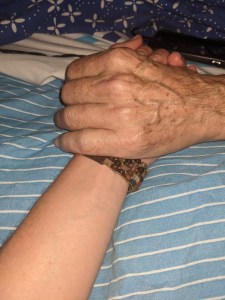
Imagine you’ve just moved your father and his broken neck into a hospice—held his neck still as he winced the entire ambulance ride. It’s the 13th anniversary of your mother’s passing.
Now you’re supplicating at your mother’s grave. You want to sing to her, like you always have, like you sang her to sleep. Like you will sing him to sleep, less than three months later.
But all you can think is: No, not again, not fucking again, I don’t have it in me, please—not again. Maybe you even say this out loud—it’s hard to hear between the wails and the snot.
Imagine understanding, for the first time, the difference between aged and fresh grief. A certain earthy bouquet de je ne sais quoi.
Ah, that’s what they mean, you think. I guess time has done something, after all.
Either way, you get up and take videos of the available plots to show your father and his broken neck, back at the hospice.
Imagine it’s your eternally sixty-four-year-old mother’s seventy-eighth birthday.
It’s been fourteen years since you celebrated together. More, actually. You can’t remember the last time you celebrated together.
But you have the last card you sent her, together with all the rest she had kept, and now the ones he had kept, and an old film box with all of your milk teeth. Everything you own in this world is right here with you, in a small octagonal structure nestled in the forests of Northern Portugal.
It’s a good feeling: compact, contained, intact. And also: sad, scary, and fragile—with a sprinkle of self-pity on top.
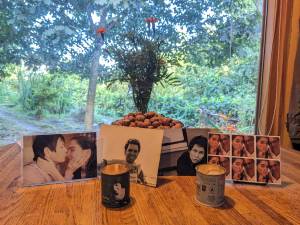
Imagine the people who remember your mother’s birthday are becoming fewer and fewer. What’s the sound of one broken voice singing Happy Birthday?
If a birthday falls in the middle of a forest, does it make a sound?
Imagine one of them lives on a tiny island almost on the other side of the planet. She is the last of your nucleus of origin. You are the last of hers.
She calls you one night just before her battery runs out, as she flees to the beach in a biblical firestorm. You want to charter a plane to get her out of there. You want to swim across the oceans, there and then. But instead, you muster some humor, for the spirits. You say: “At the Horn of Africa, turn right.”
Also for the Spirits, you make her a bed.
Imagine your sister comes from a long line of people who knew how to hide their pain and fear well. Especially from themselves.
It was an effective strategy against Cossacks and cancer. Or maybe less of a strategy and more of an attire. In any event, they wore it well. So did she. She said, “I’m not worried, I think it’s going to be okay. I’m great at emergencies—it’s my moment to shine!”
Imagine that afterward you say to your husband, “You know, my sister and I are all we have left of each other.” You say, “of each other” on purpose.
Imagine telling him you need something you won’t—can’t—ask for. Imagine him saying it anyway: “Of course. Of course she’s our family; of course we’ll take care of her if you die.”
Imagine your sister telling you she’s okay, as the world blazes behind her.
Imagine telling your husband it’s just a sprain—your hand clearly broken, your father still fresh in the grave. I’m okay, I’m okay, I’m okay.
Imagine your father walking around with a broken neck, while the doctors tell him it’s nothing. You’re okay, you’re okay, you’re okay.
Imagine the nurses at the hospice not realizing they needed to call you, as he began dying. Imagine them insisting on showering him, just before he did.
He’s okay, he’s okay, he’s okay.
Imagine telling them: “But he’s dying.”
Imagine them telling you off.
Imagine when the pain got so bad he could no longer hide it—at least not from those who really looked. You could notice, once he was already lightly sedated, that his eyebrows would furrow—just so—with each breath.
Imagine being told you’re emotional.
Hysterical.
Imagining.
You had promised your father he wouldn’t suffer, and you could tell—by his forehead— that he was. Imagine your own mythology originated in a story about your father reading something on your forehead when you were born.
That thing was: I will take care of you when you die.
You had spent a lifetime resenting that prophecy—and the prophet who told and retold it without ever realizing what it meant. What it said about you. What it said about him.
Imagine you had to take photos of him contorted with pain—his mouth agape in a voiceless cry—so the nurses would believe you. So you could keep your promise. So that the wretched prophecy could come true—in the most beautiful, harrowing way.
Imagine how right he had been, also—and how terribly wrong.
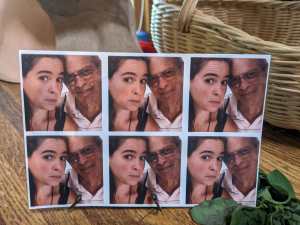
Imagine that after he died, when you went through your father’s old sketches, you found one of a man on his deathbed, with an angel overhead. He drew his own death when he was twenty-three.
He drew you, too.
Imagine that when you arrived at his deathbed, about 42 hours shy of his last breath, he couldn’t stop saying, “It’s good you came, it’s good you came, it’s good you came.” And then he said, with a twist of tragic irony, “I thought I would know when it was time.”
Imagine a prophet afraid of his own prophecy.
Imagine wondering if he had finally understood, at the very end, that yours was the true love story of his life.
Imagine that’s what he was trying to tell you when he said, “I love you,” with his last words.
You had just said, “Everything’s okay: your body’s just learning to unbreathe.”
“I love you.”
Imagine asking him to repeat himself. It was hard to hear through the oxygen mask—his voice already unvoicing.
“I love you.”
Imagine that’s what he was trying to say with his prophecy all along.
Imagine the one who loved him, warts and all, from start to finish.
Imagine me.
I’m standing over my dead father’s bed—one hand on his forehead, one hand on his heart. I’m singing to him—well, he’s no longer “him” and I’ve never been “me.”
It’s definitely not “singing.”
Still, I can hear my father harmonizing.
I can feel him harmonizing—my fingers suddenly prongs of a tuning fork.
My eyelids straining against the sweet stickiness of his spirit, as it lingers near.
My skin stretching with the universe, as it wriggles and adjusts.
***
Imagine it’s a prayer.

Postlude
Imagine I have a nearly thirteen-year-old, and in my efforts not to tell her what she is or isn’t capable of, she has gone and taught herself how to play the piano.
Imagine one day I start teaching her Faure’s Dolly. I play it with her, and suddenly, I’m twelve, playing it with my sister at my Bat-Mitzvah. Right down to the sweaty palms. Then I’m fifteen, playing it with my friend in Paris. Right down to the jitters. But somehow, I still have a nearly thirteen-year-old.
Imagine that she asks me to play it almost every day. Almost every day I get to be twelve and fifteen, with sweaty palms and jitters—and still have a nearly thirteen-year-old.
Imagine the ride.
Imagine I’m playing with my daughter on my dead mother’s Bösendorfer, the same one my sister and I played on at my Bat-Mitzvah.
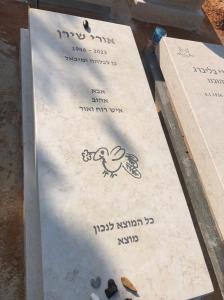
The very same one my father mutilated as he reluctantly moved out after thirty-two years of marriage, etching his signature doodle onto its ebony wing.
Imagine a bird with a flower in its beak.
Imagine how furious it made my mother. Imagine she never fixed it.
Imagine the bird here, in my little octagon, chirping at everyone who comes by.
Imagine it there, etched on my father’s grave.
Imagine me playing Bach’s first prelude with my sister, on that same piano, on my mother’s last day.
Imagine me playing it on the broken hospice piano on my father’s last day. I don’t know if he can hear it.
Imagine that’s the last thing I play before breaking my hand.
Imagine it’s four months later.
It’s my eternally sixty-four year-old mother’s seventy-eighth birthday.
I’m playing Bach’s first prelude to my parents, over and over again—broken hand, broken voice and all.
Imagine Bach’s first prelude as the key to the heavens—a secret code I have to play just right.
Imagine it’s a prayer that only works once you’ve been broken.
 All of the Worlds