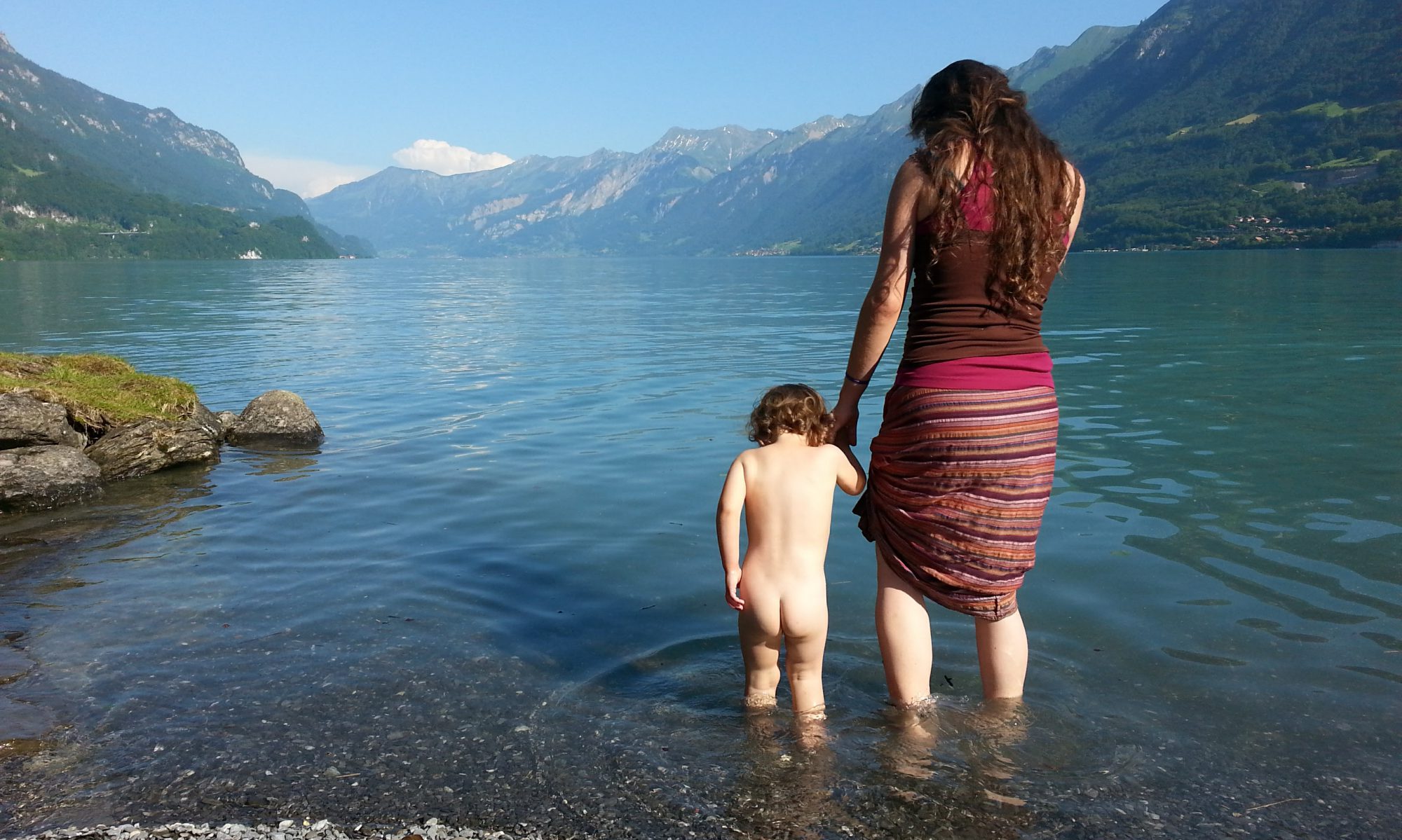
I don’t love my children the way I might love milk chocolate.
Loving them is like loving really stinky cheese, or coffee; it’s deep and primal, complex, involving so many taste buds and the interaction between them. I am sometimes repulsed and often full of craving—occasionally simultaneously—and can’t imagine my life without them.
I’m not even sure love is the right word. Torment? It’s terrible, really. Still, the love I have for them, the torment it bestows upon me, eclipses everything else in my life.
But how does one start writing about feeling like you don’t love your own child? About wishing, intensely, that they were different; about being triggered by nearly everything that they do?
About working so hard, every day, almost exclusively striving for their mental health and wholeness, and finding yourself at the end of the day, wondering how much damage your words have done—just now as you simply couldn’t take it anymore?
About grieving the widening gap between the mother you live to be and the one that you are, late in the evening, as they refuse to fall asleep?
About the warmth creeping back into your heart almost as soon as the little fingers release their grip from your hand, the resentment and rage returning as soon as they tighten back up?
How does one write about not loving one’s own child? About early morning conversations with bleary eyed seven-year-olds who, in response to your remorse about a particularly lacking bedtime routine, ask you whether your feelings would have been hurt if they had said those things to you?
Yes, you say, they would have. And I would never want to hurt you.
And about her saying, in response, that she would also never want to hurt you. Just only, when she’s really mad. That is, she always loves you, even when she’s mad, except then she doesn’t feel that she loves you. Or she doesn’t want to feel it, even if she does.
And about how it breaks your heart to hear that, but also, oddly, makes you feel better—like only a parent could understand.
Seven years ago, a little after Oliver was born—abruptly usurping Ella’s position as the cutest thing around and leaving her to audition, repeatedly, for the only other attention-grabbing role of least cute—I remember thinking: How did no one tell me about this?
I mean, they say your eldest will look suddenly huge—they do—and that you will have enough love for the youngest—I did—but not that you might (and probably will) fall out of love with your first-born.
That maybe—most likely—in order to make room for the second, you will need to separate a little more from your first. That maybe, that will make you feel like you love them less.
And that maybe, because nobody told you this might happen, and that it’s okay—even healthy—it will claw at your soul and erode your sense of goodness. Or something to that effect.

I remember staring at the grout lining the white tiles in our bathroom, deeply mortified by my feelings, barely managing to send a feeble S.O.S. message to my dear friend.
Having had her second child two years prior, she could hear through my agonized silence and simply said, Yes, I know. Then she sent me a snippet from a beautiful poem by the Israeli poet Dahlia Ravikovitch, titled, “The real love isn’t as it appears.”
Roughly translated, it reads: “And do we love our children? Sometimes we love our children, / And even then mostly in a limited way / As a citrus tree loves the orange, / And beyond that a series of misunderstandings / That is gobbled up with the real love.”
I felt so vindicated, then, by the permission to love my children in a “limited” way, by the promise that I can still be a citrus tree and they can still be my oranges, by the focus that she draws to that which she refers to as “the real love”: the commitment to engage with the messiness of the relationship, head-on.
I still find great comfort in the idea that the love we have for our children is like the love the citrus tree has for its oranges: matter of fact, pragmatic, prosaic, existing simply by virtue of being and belonging.
And with time, I’ve come to think of those moments when we cannot feel the warm and fuzzy as our greatest opportunities to practice real love.
What if instead of fearing them and pretending they weren’t happening, we’d welcome them with open arms—even seek them out? Savor those moments when the reflection in our little mirrors grows fuzzy, when we are nothing but disapproval?
When they are nothing but them?
What if real love is allowing them to be sometimes unliked but always loved, caring for them, truly, even as they slowly dance away from us into their own shadows?
What if love is continuing to show up on that dance floor, even when we don’t share a beat?
Ella turned twelve this week. She’s a giant of a person, a colossus, and it seems increasingly implausible that she emerged from my body, born of a moment.
But my womb, she remembers.
And celebrates: I couldn’t sleep a wink that night, the twelfth anniversary of my water breaking in bed and of the long liminal dance that eventually brought us this lioness of a person, the baby who roared just as soon as she physically could, her body still part of mine.
I can never sleep on the anniversary of her birth, my body remembering even when the mind forgets. She was born exactly a year after we moved back to Israel to take care of my dying mother, who died exactly two months after that.
So, Ella’s birthday marks the beginning of my very own “Bein ha-Metzarim:” the dire straits between a birth and a death—a two-month period that is the anniversary of my mother slowly leaving.
I am always caught off-guard by the tenderness of this time of year, invariably surprised by the sleepless night that intimates Ella’s birthday.
Like a possessed puppet, I appear to be destined, for the second half of my life, to go through the motions of a disjointed choreography haphazardly put together in the first.
The body remembers, even as the mind tries to forget.
On the morning of her birthday, as she descended into our bed and stuck her head under my chin—it barely fits—I gave thanks again for the cuddliness of the current incarnation of my child. Unlike Oliver, who was born already hugging, Ella was not initially one for spontaneous exchanges of affection.
Sniffing her head, I was transported to my own Bat-Mitzvah, thirty years ago—to my mother inviting me to nap in their bed before the evening’s festivities.
How memorable it had felt, already then, lying awake next to the naked prototype of the body I was busy becoming. And how excruciating things were about to turn, how painful thirteen was, how many incarnations on my way to forty-two.
Over the last few years, we’ve developed a shared nostalgia, Ella and I, for all the little Ellas who have come and gone so far. It’s as if we’re remembering old friends in a foreign land, little adorable gnomes with whom we used to hang out and whom we would like to go visit again—even though we know we can’t, not quite.
We long, together, for a person gone: not exactly gone but nestled like a little babushka inside a babushka inside a babushka inside the current version of my child.
Yearning for those beta versions on my own feels wrong, like a betrayal.
There is great comfort in that shared reminiscence—a little like telling your partner, anxiously, that you have a crush on someone else and having him say, “I get it, he’s cute!”
In no other relationship is it okay to change in this way—unilaterally, abruptly, and serially—and as parents, we are expected to welcome these changes without question, without allowing our grief to dampen the love we have for our new babushkas.
Often there are limbo moments as we straddle two babushkas, the old and the new, when we suddenly realize we are no longer following the beat of our children’s dance.
They have a distinctive flavor, those moments, a musky medley of confusion and despair. Eventually we find it and breathe a sigh of relief as we slide back into complacency. Until the next time.
They become less frequent, but they continue to happen. It might take longer to find it—sometimes we can’t—but we keep searching for that beat. We show up on the dance floor.
Many years ago, in the early aughts, I spent a few agonizing days building up the courage to tell Haffy that I wanted to start wearing skirts. I remember, still, the quizzical look he gave me as I shared the news, following what must have been a rather alarming but retrospectively amusing preamble.
We had been together for several years by then—already a secretly married couple who did not believe in marriage—and something about having someone witness me so intimately and regularly made me feel like I needed to acknowledge the change.
I wasn’t asking for permission, as such—I think I was giving him a heads-up that a new wave was coming, so we could ride it together. That I was donning a new babushka, I was performing a reverse-chrysalis maneuver, re-calibrating the parameters of “me.”
For the many waves that have followed in the last two decades, a nod has normally been enough, like that of a soloist cuing her accompaniment. But sometimes one of us will sit the other down and stumble through an awkward preamble until they join the wave.
Sometimes we admire the other as they ride a new wave, from ashore.
And sometimes we are too busy building our own sand castles to notice the other waving as they zoom by.
This past June Haff and I celebrated twenty-one years together: half my life.
September marked the twentieth anniversary of our McDoland’s wedding—our secret NY City hall production-chain wedding, Haffy in his borrowed orange sneakers.
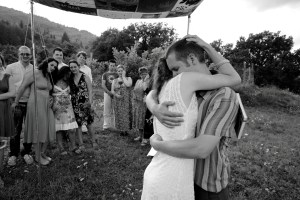
And just two weeks before that it was fifteen years to our Tuscany wedding, the one with the patchwork Chuppa, our eighteen guests (one dying mother, one temporarily-estranged father), and our made-up vows.
It’s a choreography to behold.
I struggled, then, to write my vows—I struggled to pretend-marry a man I had already been legally married to for five years; I struggled with the quantum collapse of my lives.
So that’s what I wrote about: I said, It’s hard to choose. Choosing you means not choosing so many other lives. Still, I choose you. Today.
Let’s see about tomorrow.
We kissed.
If I had written those vows today they would say just this:
To love someone is to choose to care for them, over and over again, and to be loved back is pure good fortune. Let’s be lucky together.
I choose you for my kin: I promise to love you, today and forever, even when I don’t like you—especially when I don’t like you. Fuck in sickness and in health: In like and in dislike.
I promise to always do my best to be kind—to value your well-being alongside mine, even above mine.
If I need to leave, I promise to leave you well.
Or I would simply quote Vonnegut and say: “Love may fail, but courtesy will prevail.”
I might replace “courtesy” with “kindness.” Or I would replace “love” with “infatuation,” and “kindness” with “love.”
It would all mean the same, simple thing: We will always be each others’ oranges, and we will always be each others’ citrus trees.
And also, please let us be kind.
When I was fourteen, I wrote an autobiography in the third person about an alien born on earth.
I didn’t think it was unusual—it was simply how I had always understood my story—but I could tell my teacher was a little taken aback, though impressed, and couldn’t quite decide to which feeling to attend first.
My mother and I were living in the suburbs of Manchester at the time. We would go back and forth to Israel every six weeks, to keep up the pretense of a family that was, already then and arguably since its very inception, coming apart at the seams.
On one of those visits to Israel my mom had a mammography she had been putting off, and the rest is, well, herstory. But that took fourteen more years to unfold.
In the meantime, I had a flight to catch back to an ailing mother, and brown rice to cook, and carrots—cut just so—to steam, and tears to stifle back as my mother told me she wanted to die. And all I had left from Cheadle Hulme High was a draft of an autobiography, a skirt and a tie.

At some point, when my mother was well enough to notice I had not been attending school for a while, they enrolled me, somewhat reluctantly, in the local arts high school.
It was the middle of the school year, and by then I had quite a lot of experience being the new girl in class—I had changed schools every two years on average, and sometimes, continents.
Still, I remember well that morning when my form teacher introduced me to the class, and there was only one spot left to sit. It was next to a tall girl in paint-covered jeans overalls.
She smelled like soap and earth and something sweet and a little sour.
In my mind it took us some time to warm up to each other, but in reality, I guess it was not long before that fateful day when she jotted down the lyrics to “Break on Through” in her notebook and I corrected her spelling mistakes, sparking a 27-year long love affair.
Or so I had thought, until a year ago–when it ended, abruptly and unilaterally.
On our first outing together we went to the flea market in old Jaffa and bought two of the ugliest dresses one could imagine—mine a variation in purple, hers in green—that we both cherished for an inexcusable number of years.
We came back to my childhood apartment—one of them, anyway—and I kept waiting for her to leave, but instead she opened our fridge and fell asleep on our sofa. My mother was not impressed. I was undecided.
But somehow, we grew on each other. We grew with each other.
She and I would walk around the school muttering “psychedelic somewhat” about everything. We thought it was absolutely hilarious, and even then I was never quite sure why.
She would bake breads and fall in love with boys, and try to hide her frustration when I got higher marks, even though we had studied together. She would ask all the questions I was too proud or shy to ask.
She was the secret witness at my City Hall wedding with Haff—he wore her then-boyfriend’s orange sneakers—we crashed in their basement until we found a place of our own.
She was there after my mother died, and when my Ella cried her first cry (and a few subsequent), and I was there for her first two births, too. I was on the phone from France for her third. At the hospital, after my surgery, I saw Haffy, my father, and her.
That is to say, she is—as Google likes to remind me—all over my fucking photo albums, dating back to 1994.
After my mother died, I didn’t dream for a year. Not just about her—I didn’t dream at all: my nights were dark and silent, and I would wake up gasping for her. I went back to dreaming, eventually, but my mother still mostly stays away.
When she frequents me at night, she is generally frail and dying, possibly already dead—but somehow alive—and deeply unhappy, mostly with me. Or with herself. I’m never quite sure of the difference. There have been a choice few times when her nightly presence has been nourishing, protective.
After my friend became a ghost, I dreamt about her daily, for months. She was always furious with me—they were—and I had always done something unpardonable, though it was never quite clear what.
I would wake up in sheer terror at 2am sharp, gasping for a reality that made more sense, that wasn’t adversarial and ultimately unsolvable, that would fit with my understanding of myself and the world as I had known it until then. I would lie awake in bed for hours, my heart beating so fast I was starting to get worried there was an actual emergency—besides, that is, my heart having been broken.
Eventually the dreams became more infrequent, and lately, when she shows up, she’s friendly—too friendly, in an entitled sort of way, for someone who left without even saying goodbye.
It took me time to realize it was a break-up, that she had dumped me (and my family), that we were done.
It took me time because I haven’t had many break-ups in my life, certainly not after 27 years.
I remember the angsty agony of crying in bus stations on the way to school when my Canadian cyber-boyfriend—always ahead of my time—left me for a real-life woman.
They got married and still live happily ever after, if you believe that. But before that, he helped me through my mother’s first cancer, being fourteen, and the opening scenes of my parents’ drawn-out divorce.
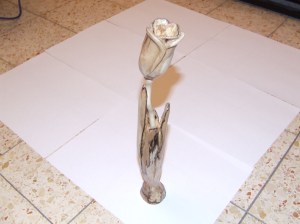
I wrote him, many years later, to thank him for all of those things. I was twenty-eight, on a semester’s leave from NYU, taking care of my mother who was dying from her second cancer. Haffy was my cyber-support then, our brief stint with long-distance love. For my birthday he sent me a hand-carved tulip, only stabbing himself once.
It hangs, now, above the entrance of the Octagon, blood stain and all.
But back then, at the bus stop, all I could feel was the disorientation and shameful loneliness of an orange who had been found to be unworthy of her tree—the phantom pains of a tree, suddenly gone.
It took me time to realize it was a break-up because I refused to follow a plot where only her heart mattered, not mine. It was my first time being ghosted, and I could hardly believe how irrelevant I’d become.
It took me time to realize it was a death, though I have had more intimate experience with those. It was the phantom urge to call her, every few days, that gave it away.
It took me time to realize that it very nearly killed me.
It certainly killed the version of me that felt loved by her–the Tal I had understood myself to be through her eyes–her ghost reaching back in time and extinguishing them, Terminator-style, before they could even cohere.
And it killed the core part of me that believed I was cherished and understood, that I was an orange with many citrus trees and a tree with many oranges. The part that believed I had deep roots in a grove that would extend its branches to shield me—that would insist that my heart is not a thing to be trifled with, vouch that I am me.
I was left a lone tree in the desert, my mycelial grief a mirage only very few could see.
When offering condolences, I steer clear of platitudes such as “May you never know more sorrow,” or the absolute worst: “Time will heal all wounds.”
I’m the one going, “Hmmm, Time? Not all it’s cracked up to be. Grief? Probably here to stay. Might as well befriend it! Children? Not for the faint of heart. Humanity? Good luck with that.” And so on.
Lately, though, I’ve been spending some time with the traditional Jewish offering, “May her memory be a blessing.”
Anyone who’s experienced grief knows what a mixed bag memories of the dead can be. What a true blessing to feel wholly nourished by those memories, instead.
I know that’s not exactly the original intention of that phrase, but it is what I mean when I offer it.
More specifically, I mean: May you not suffer terribly when you remember the person you’ve lost, like I do every time I think of my ex-friend.
Time, it turns out, only makes the unforgivable worse.
What I need, if anything, is less time: I need to go back to that moment just before she decided ghosting me was the right thing to do—or even, a possibility. I want that timeline.
I need to go back in time and tell myself not to sit next to her, back then, in the ninth grade. Not to correct her spelling mistakes. To tell her to wake up, get off our sofa, and go home.
To get the hint when she tossed me aside the first time—then, too, for a narcissist partner who didn’t like the competition.
I need to go back in time and not give my heart to someone who would be so careless with it.
I don’t enjoy this kind of time travel.
Here’s the kind that I like: I smile at myself in the mirror in the morning and go visit my twenty-one year-old self as she looks at my friend who is lifting the handbrake, outside a hostel in Picton. I whisper in my ear: One of your lives awaits you in that other place, tell her to put the handbrake down.
I make a practice of this, of smiling at myself in the mirror and visiting my younger self, lest this particular space-time continuum be disrupted. I’m my own guardian angel, my very own fairy godmother. I remember me there—if “memory” is the correct term for a presence, also in your past, that came from your future—looking at my lives from the outside in.
Other times I squeeze in between my naked mother and my twelve-year old self. I lie there for a bit, soaking in the mauve curtains and the scent of my sleeping mother, relishing the quiet before the storm. Eventually I lean into my ear and whisper: Remember this.
Or else I go sit by myself in that bus station, as I stumble through my first break-up. I smile at that teenage angst, vintage of 1980. I do my best to appear comforting, not condescending.
Then I whisper: May his memory be a blessing.
Freshly back from one of my temporal jaunts I suggest to Haffy that he should make occasional practice of visiting his younger self to make sure he meets me there, at the crack of New Zealand’s rear end.
But his grasp of time and space and reality has never been as tenuous as mine: He’s already there, always waiting. He is already building our home, before we were us, before there was where, unimpressed by time as it runs sideways.
So instead, I learn to join him, after a time, in the aftertime—walking our land here, but later.
I sing to the avocado trees, talk to the mushrooms. They’re the closest we have to citrus trees.
She who could not dream, I walk the rooms of our not-yet permitted house, steep in our imaginary hot tub, greet our phantom guests.
I’ve become so good at it I sometimes have a hard time telling here and now from then and there.
Or why it even matters.
 All of the Worlds
beautifully written ….
serendipitously finding this gift
at 04:14 am January 1st 2024
In a velvet star studded night
Laikipia Plateau
North of Mt Kenya
so moved… thank you thank you
💛
LikeLike
Hey Someone. How serendipitous for me, too, for my words to have touched you–there, then, under that starry sky. And for you to have shared that. Thank you, thank you.
LikeLike